Included on every job
Infrared and thermal imaging, on every inspection we do
Roof, building envelope and electrical infrared, read by a Level II Thermographer, with drone deployment for the roofs nobody should walk. Non invasive, so nothing gets opened up to find it, and it is not a line on your invoice.
Chapter 01
What infrared sees that a flashlight cannot
Thermal imaging is an advanced, non invasive technology that shows a client things about their building which conventional inspection methods cannot reveal. It does not see through walls, which is the common misunderstanding. What it reads is surface temperature, at a resolution fine enough that what is happening behind the surface shows up as a pattern on it.
Wet insulation holds heat differently from dry insulation. A stud reads differently from the cavity beside it. A missing batt reads as a cold rectangle in a warm wall. Water tracking from a roof leak reads as a plume that points back at its source. An electrical connection running hot reads as a bright spot on a closed panel cover. In every one of those cases the camera finds it without anything being cut open.
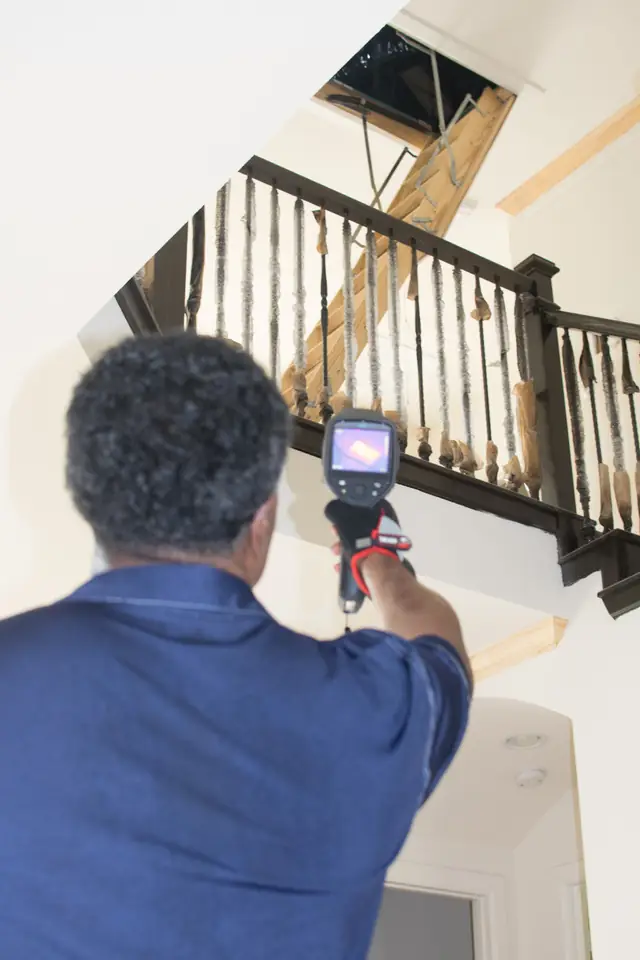
Handheld thermal imaging camera in use during an inspection
Roof, envelope and electrical, which are three different jobs
Roof infrared inspections find moisture trapped inside a roof assembly. On a built up or ballasted commercial roof that trapped water is what destroys the deck from above while the membrane still looks serviceable from a walkthrough, and it is close to invisible any other way.
Building envelope infrared inspections read insulation and air leakage across the whole exterior: where insulation was missed, where it has slumped, and where conditioned air is leaving. Electrical infrared inspections read connections and equipment under load, which is the only condition in which a failing connection actually declares itself.
Chapter 03
UAV deployment, for the roofs you should not be walking
Some roofs cannot be walked safely, and some should not be walked at all because walking them is itself damaging. A drone carrying the camera solves both, and on a flat commercial roof it does something a person on the roof cannot: it holds a consistent height and angle across the whole surface, so the thermal pattern can be compared from one end of the roof to the other.
That is also what makes the roof level ponding survey possible, where elevation differences are measured across a grid against a centre reference point to find where water will stand.
Included at no additional cost, and why that is unusual
Every home and commercial inspection includes thermal imaging diagnostics and the description analysis that goes with them, at no additional charge. This is one of very few inspection services in Dallas that does it that way.
The reason to mention the price is that the alternative arrangement, where infrared is sold as an add on, quietly changes what gets found. An add on is something a buyer declines when the budget is tight, which means the findings that only infrared produces go unfound on exactly the transactions where they would have mattered most. Including it removes that decision from the process.
Trevor Battieste, Level II Thermographer. Member of United Infrared and the Infraspection Institute.