Standing water on a flat roof, and how a drone survey measures it
A flat roof is never flat. The question is where the water goes, and that is answerable rather than arguable.
September 17, 2026 · 3 min read
If you own or are buying a building with a flat roof, there is one question that matters more than the age of the membrane: where does the water stand after it rains. Ponding is what shortens a flat roof's life, and unlike most roofing questions it has a measurable answer.
Why standing water is the problem
A flat roof is never actually flat. It is built with a slight slope toward drains, and over decades the deck deflects, insulation compresses, equipment gets added, and the slope stops going where the drawings said it went. Water that used to leave now sits.
Sitting water does several things at once. It loads the deck in exactly the area least able to carry it, because a low spot is low for a structural reason. It accelerates membrane ageing at the seams. It grows biological material that holds more water. And on a ballasted roof it moves the gravel around, which matters because that gravel is not decoration. It holds the membrane down and shades it from ultraviolet.
Walking a roof is not measuring it
The traditional approach is to go up after rain and look for puddles, or look for the tide marks and debris rings that show where water has stood. That is genuinely useful and it is part of any competent roof inspection. It is also an opinion, formed from eye level on a surface with slopes measured in fractions of an inch per foot.
Two inspectors can walk the same roof and disagree about which areas are low, and neither is being dishonest. Standing on a surface is a bad vantage point for judging the flatness of it. There is also the matter of safety: some roofs should not be walked at all, and on some the act of walking causes damage.
What a roof level survey produces
A roof level survey flown by drone measures elevation differences across a grid, relative to a single centre reference point on the roof. Instead of an impression of where the low areas are, the output is a set of measured deltas across the whole surface, all taken from a consistent height and angle.
That changes the conversation in two ways. First, the low areas are identified rather than argued about, and they can be shown to a roofer, a seller, or a lender. Second, the fix becomes specifiable rather than general. Recommendations come out as work that can be priced:
- Inner drains added at the locations where water genuinely collects, rather than where the original drawings assumed it would
- Gravel ballast redistributed back over the areas it has migrated away from
- Drainage paths corrected where added rooftop equipment has interrupted them
Flying the camera also carries the thermal inspection at the same consistent height, which is what allows moisture trapped inside the roof assembly to be compared honestly from one end of a large roof to the other.
What else is on the roof
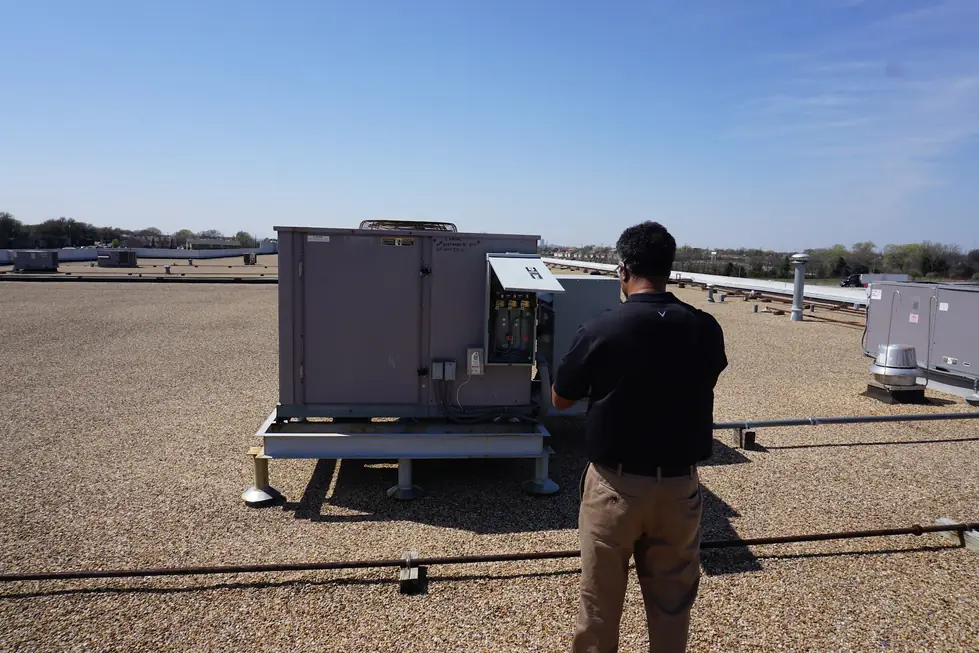
Ponding is the headline, but a roof inspection covers everything up there, and the equipment is usually where the findings cluster. Rooftop package units get checked through their normal controls, along with the things around them that get forgotten: whether there is permanent access to the unit at all, whether a service platform is required at this roof slope, whether the electrical disconnect is labelled and has working space in front of it, and how the condensate actually leaves the roof.
Then every penetration individually. Vents, flashings, skylights, chimney and every other hole somebody has made in the roof over the years, because a roof does not usually fail in the middle of a sheet. It fails where something passes through it.
When to have it done
The obvious moment is during due diligence on a purchase, where the roof is often the single largest capital item in the five year cost breakdown and the difference between a resealed roof and a replaced roof is a six figure swing.
The less obvious moment is when you already own the building and the roof is somewhere in the middle of its life. That is the point at which drainage corrections are still cheap and still worth doing, and it is much earlier than the point at which a roof starts leaking into a tenant's space.
North Texas Property Inspections, (469) 569-4212
Call (469) 569-4212More articles
What a Dallas home inspection actually covers, system by system
Three to four hours, sixteen system groups, and a report the same day. Here is what is in it.
Why a thermal camera comes out on every single inspection
Infrared does not see through walls. What it does is stranger and more useful than that.