Why a thermal camera comes out on every single inspection
Infrared does not see through walls. What it does is stranger and more useful than that.
September 17, 2026 · 3 min read
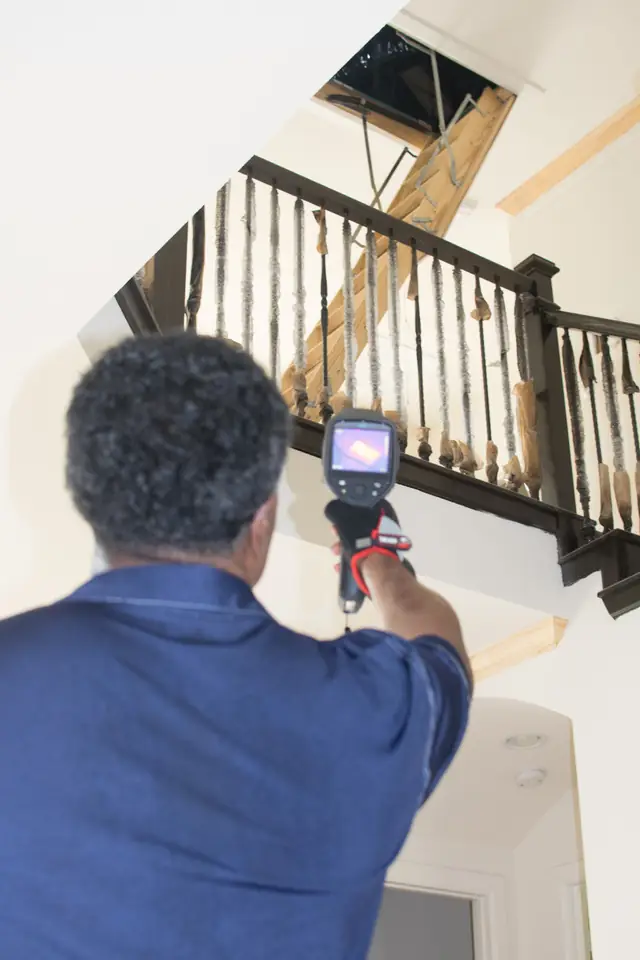
There is a common misunderstanding about thermal imaging, and it is worth clearing up before anything else: an infrared camera does not see through walls. It reads the temperature of surfaces. The reason that turns out to be so useful is that what is happening behind a surface changes the temperature of the surface itself, in a pattern fine enough to photograph.
What the pattern tells you
Materials hold and move heat at different rates, so a wall that looks uniform is not thermally uniform at all. A few of the things that show up:
- Wet insulation holds heat differently from dry insulation, so moisture inside an assembly reads as a distinct shape
- A stud reads differently from the insulated cavity beside it, which is how missing or slumped insulation becomes visible as a cold rectangle
- Water tracking from a leak reads as a plume that points back toward where it got in
- Air leaving a building through a gap reads as a streak, not a dot
- An electrical connection running hot reads as a bright spot on a closed panel cover, before anything has failed
In every one of those cases the finding arrives without anything being opened up. On somebody else's house during an option period, that is the difference between finding it and not.
Three jobs, not one
Infrared inspection is usually talked about as a single capability, but it splits into three quite different kinds of work. Roof infrared inspections find moisture trapped inside a roof assembly. On a built up or ballasted commercial roof, that trapped water is what destroys the deck from above while the membrane still looks serviceable to somebody walking it, and it is close to invisible by any other method.
Building envelope infrared inspections read insulation and air leakage across the whole exterior: where insulation was missed, where it has settled, and where conditioned air is escaping. Electrical infrared inspections read connections and equipment under load, which is the only condition in which a failing connection actually declares itself. A dead panel tells you nothing.
The roofs nobody should be walking
Some roofs cannot be walked safely and some should not be walked at all, because walking them is itself damaging. Flying the camera on a drone solves both problems, and on a large flat roof it does something a person on the roof cannot do: hold a consistent height and angle across the whole surface, so the thermal pattern at one end can honestly be compared with the pattern at the other.
That consistency is also what makes a roof level ponding survey possible, where elevation differences are measured across a grid against a centre reference point to establish where water will actually stand after it rains.
Reading the image is the skill
A thermal camera produces a colourful picture almost immediately, and that is exactly the problem with it. Colour on a thermal image means whatever the scale was set to, and a pattern can be a genuine defect, a reflection, a difference in surface finish, or simply the sun having been on one part of a wall an hour ago.
Thermography is a trained discipline with real theory behind it, and the certifying bodies exist because of this. The Infraspection Institute is the oldest independent infrared training and certification firm in the world, founded in 1980, and it has trained and certified roughly ten thousand thermographers. United Infrared is a nationwide network of infrared thermographic service contractors. Holding a Level II Thermographer qualification is the difference between owning a camera and being able to say what its output means.
Why it is not a separate line on the invoice
Every home and commercial inspection here includes thermal imaging diagnostics and the analysis that goes with them, at no additional charge. That is unusual enough in Dallas that it is worth explaining why, because the reason is not generosity.
When infrared is sold as an add on, it gets declined. Specifically, it gets declined by the buyers whose budget is tightest, on the transactions where an unexpected repair bill would do the most damage. The findings that only infrared produces then go unfound on exactly the purchases that could least absorb them. Including it by default removes that decision from the process entirely, and it means every report can honestly claim the same coverage.
It also changes what an inspection is. Without a thermal camera, a wall is a painted surface and the report can only describe the paint. With one, it is a surface carrying a temperature pattern that says something about what is behind it.
North Texas Property Inspections, (469) 569-4212
Call (469) 569-4212More articles
What a Dallas home inspection actually covers, system by system
Three to four hours, sixteen system groups, and a report the same day. Here is what is in it.
Buying a commercial building in DFW: what a nine category inspection finds
A list of defects tells you a building has problems. A sequenced cost breakdown tells you what to offer.